A POET? MOI?

ODE TO A WRAITH

(A mortgagor’s lament)

Banksters lending into a bubble

was a recipe for trouble,

but their lending bravado

sent prudence out the window

as they led Australians astray

with mortgages they couldn’t repay.


Now bank CEOs have government’s ear

in promoting the fear

that they are too big to fail.

And “We’re not overpaid!” they wail

as the frauds they’ve perpetrated

leave mortgagors devastated.


It has always seemed to me

this happens too regularly,

so maybe the Henry Tax Review

should be listened to

in saying we need an all-in land tax.

That would keep bubble mortgages off our kids’ backs!


Land prices have proved to be a phantom,

that come and go with abandon;

and for such a wraith,

it is a misplaced faith

on which we securitise bank loans

but can’t foresee mortgagors’ despairing groans.


THE END!

_______________________

NEWS ITEM


FREE, BUT INVALUABLE, ADVICE FOR MR PRESIDENT

OK, President Obama. Forget the crap, forget the glitz: get down to work.

If as you say “The best is yet to come”, it’s time you got serious. You’re facing the fiscal cliff and your economic advisers have failed you – badly.

You need more than rhetoric. Discover land rent.

It’s one-third of the economy, most of it stolen by rentier plutocrats.

You need to study and heed what these economists have had to say:-

Joseph Stiglitz: “Rent is the secret tax the wealthy charge the poor.

Michael Hudson: “The way to prevent real estate bubbles is to tax the land rent. The basic principle at work is that whatever rent the tax collector leaves ‘free’ is available to be pledged to the mortgage banker as interest – to carry a yet larger loan.

Steve Keen: “The problem is that Australia’s central bankers have fallen for the usual occupational hazard of men in their profession: they have only one trick in their toolbox: supplying credit to influence the interest rate.

And listen to these guys from the past, because they knew their economics, too:

John Locke:  “The things of nature are given in common.

Henry George:  “Make land common property, but let individuals who now hold it retain …. possession.

OK?

Now get to it, or else your Presidency is going to get much worse before it gets any better.


The Great Australian Land Bubble

BY STATE AND PROPERTY CATEGORY

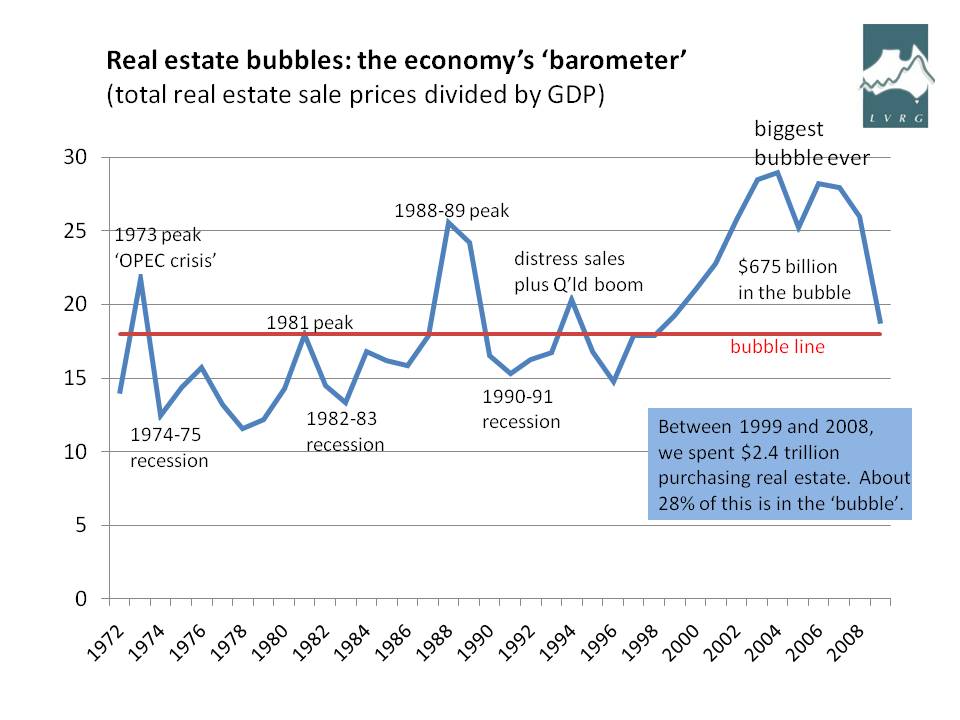
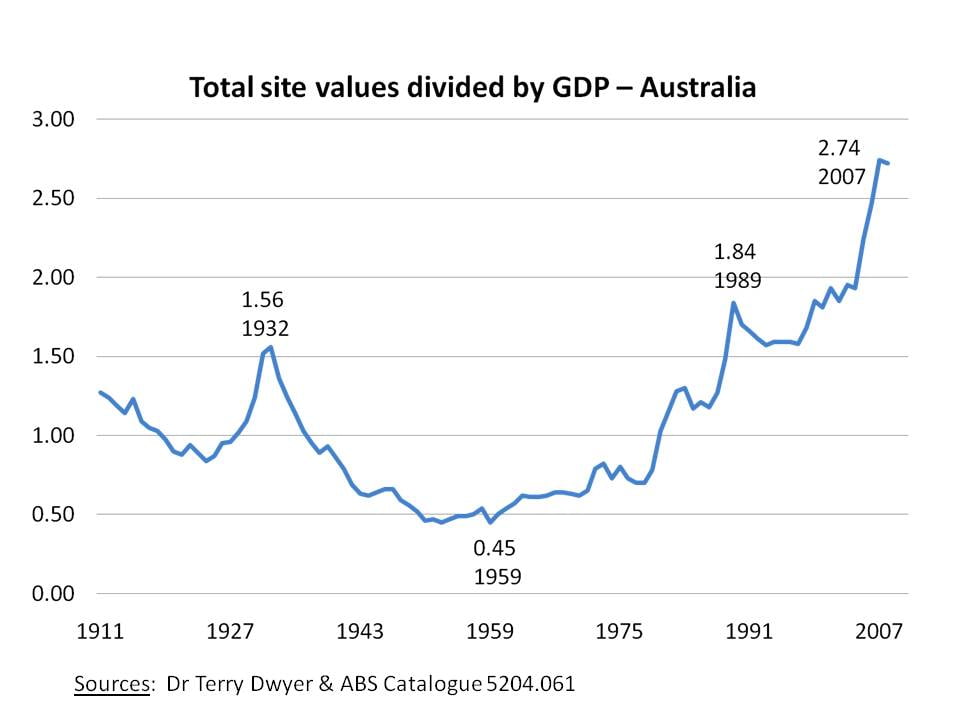
The Land Values Research Group’s Director, Dr Gavin Putland, has just compiled these telling new comparative land value charts based upon Australian Bureau of Statistics’ Catalogue 5204.0, Table 61.

Our regulatory bodies, including the Reserve Bank of Australia, quite obviously did nothing to keep the greatest real estate bubble in Australia’s history from developing.

One may very well ask what purpose all our regulatory bodies and the Productivity Commission really serve.

Despite a long history of recessions and depressions having followed the bursting of land price bubbles, Australian Treasury officials and politicians also continue to ignore that these bubbles come at the expense of productivity and social cohesion.

Why?  Is the parasitic rentier class that bullet-proof?


WHY AUSTRALIA IS DOING IT HARD

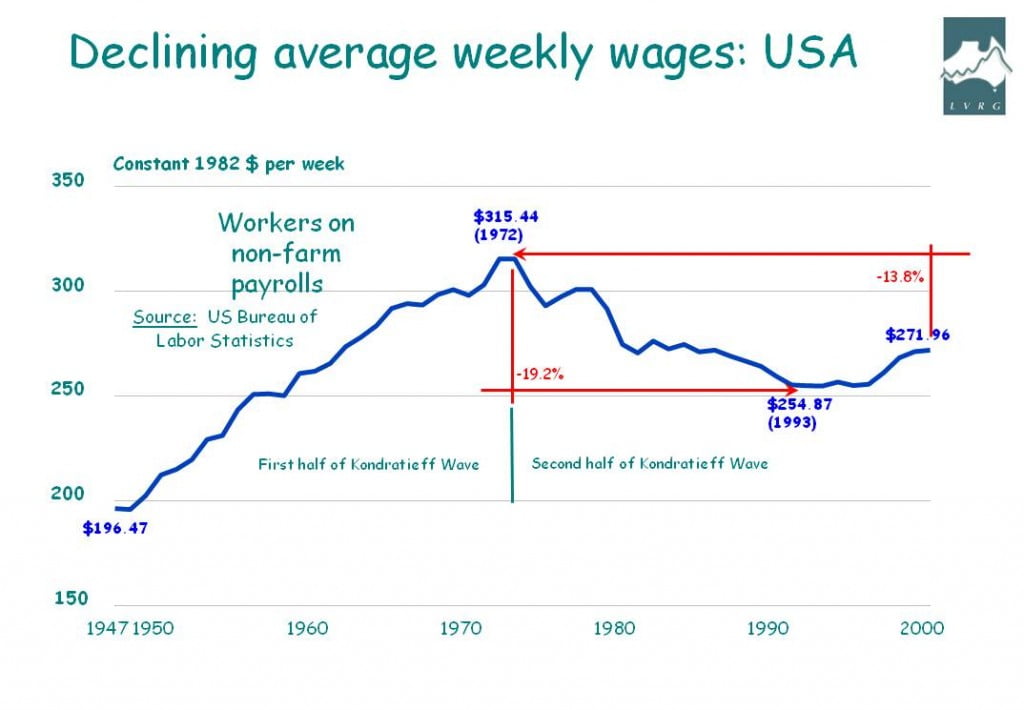
Dr Gavin Putland shows real wages and salaries to GDP have been kept down in Australia, as elsewhere, because land prices to GDP have been up enormously.

You can’t have them both up together.

When Australians appreciate this simple fact, they may begin to see the warm inner glow they feel when their property values escalate upwards rapidly is sorely misguided.

But as our love affair with real estate is often irrational, I’m betting most of us will be unable to accept the point.

This is the crux of failing economies.


US ELECTION: Milwaukee today

“As long as there is a child in any place in Milwaukee, any place in Wisconsin, any place in this country, who is languishing in poverty and barred from opportunity, our fight goes on”, President Barack Obama told an estimated crowd of 20,000.

“Our fight goes on because America has always done best when everybody has got a fair shot”, he added with a populist flourish.

How about some action against the rent privatizers then, Mr President?  That will win the fight for opportunity and freedom from poverty. Anything at all in that regard because, surely, that’s what the banksters have been up to? No? Nothing at all? Why not? Oh, it was Wall Street helped bankroll you again?

Obama also hit out at what he says is Romney’s effort to roll back the clock to the days when Wall Street had “free rein to do whatever” it liked, contributing to “an economic crisis that we’re still cleaning our way out of.”

Oh, really? Cleaning up Wall Street?  How exactly, pray tell, Mr Prez? A charge against land rents, maybe?

“And governor Romney now is a very talented salesman,” Obama added. “So in this campaign, he is trying as hard as he can to repackage the same old ideas that didn’t work and offer them up as change.”

And, despite the rhetoric, you’re not doing a bad job in that regard yourself, boyo!

By failing to euthanize the rentier parasite, the candidates of both parties are ensuring the US depression will linger.


2012 KAVANAGH-PUTLAND INDEX

Dr Gavin Putland’s 2012 update of the Kavanagh-Putland Index continues to show there’s a BIG crunch ahead, but the timing remains indeterminate.

The bust’s timing, of course, depends on how long governments can continue kicking the can down along the road; that is, artificially supporting the Australian bubble in land prices instead of adopting programs to address the damaging outcomes that must accompany its inevitable bursting.

Will we support the banks – or the people?

Despite all the evidence now showing austerity in favour of the banks overseas neither assists people nor economies–surely people and economies are the same thing anyway?–I’m betting an ALP or Liberal government will nevertheless consider people are less important than banks.

That’s in the DNA of crooked governments.


US DEVASTATION (AND REPAIR?)

9/11 (2001) was a despicable terrorist attack that changed America forever. Then, Hurricane Katrina struck to destroy New Orleans and surrounds in 2005. This was followed by the 2007 to 2009 stock market crash, and now Super Storm Sandy hits the east coast on 29 October with horrific results across Atlantic City, New Jersey and New York.

And that’s not to mention a number of wildfires and other hurricanes to which the nation has been subjected in recent years.

So what’s next for Americans? They’re surely overdue for a run of good luck.

In my visit to the US, I took the opportunity to take a peep at The Wall Street Journal and the New York Times. I thought the appearance of the Times, particularly, came up short in comparison with The Age at home in Melbourne, where the pictures are eminently sharper and more visible on a superior quality paper. I reckon our layout is better, too. But newspapers are struggling pretty well everywhere.

Interestingly, I believe I obtained my best information, not from newspapers nor television, but from speaking with a number of seemingly ever-friendly Americans, despite being beset by mounting natural and social disasters. Not journalists, not ‘experts’: people with everyday cares. People in Central Park, bus drivers, waiters, people in hotels and airports, “Occupy New York” demonstrators who know something at the top is also politically amiss and want it fixed.

I was particularly interested, of course, in how people had adapted to the financial collapse, because that’s a man-made occurrence that the nation has in its power to turn around.

Not once was I let down in talking with Americans; their analyses were always considered and thoughtful. Especially Tony, who took us on a tour of the Hollywood, Beverly Hills area. I’d vote for him if he stood as my political representative in Australia.

Natalie, the young New York waitress, had first disabused us that America didn’t appear to be suffering. “You don’t see that we’re holding onto our jobs – if we have one”, she said, “and not contemplating changing it. You don’t see that we are desperately paying down debt and amending our spending to go without in many areas. This has a compounding affect and it certainly impacts on our lives.”

“You’re Australians?” young singer-songwriter/waiter Scott asked us at Universal City in Los Angeles. “You haven’t had a financial collapse yet, have you?” he asked.  “We’re on our way to a national debt of $17 trillion”, he volunteered. “Well, you’ve actually just gone past $16 trillion”, I said, surprised, because I’d not revealed my particular interests. (Perhaps it must show, I thought.)  For a minute or two an exchange on economic matters ensued before Scott had to attend to another customer.  He returned later during our meal with what I think must have been a couple of Midoris “Compliments of the manager for our Australian visitors.”

The pleasantness and professionalism of Americans we met was more than impressive. Unfortunately, our service doesn’t always come up quite so well back home.

The most common thread in speaking with people was that they believed they were being dudded by the big guys at the top politically–whether Democrat or Republican–that, and the banks.

Something basic needs changing came through again and again.  Although people want change, there’s not much sign they’re getting any.

It was only when I had a good chat with Justin at “Occupy Wall Street” that I let my proclivities slip by mentioning that I know Michael Hudson.  “Oh, Michael’s spoken here”, he said, handing me a copy of The Debt Resistors’ Operations Manual:  “It’s free.” He mentioned he’d been attending “Occupy” at Trinity Church Wall Street (on Broadway) for 158 days.  I made a donation.

Natural catastrophes and 9/11 aside, most Americans are clearly doing it hard during the country’s financial demise. Add the natural disasters back in, and daily life amounts to a quiet heroism for many.

It’s a shame they allow the tax and political system to divide them and to create such pettifogging hatreds.

That’s what’s been really laying waste to America.


AMERICANS FOR TAX REFORM?

This BBC interview with Grover Norquist, president of Americans for Tax reform, attracted my attention overnight.

As with President Obama and challenger Mitt Romney on the subject of taxation, Norquist is partly correct: taxation and excessive government is indeed a problem. As it has always been, it is the stuff of revolutions.

But Norquist’s well-researched data and detail is simply part of the mindless bifurcation on taxation in American politics (and elsewhere), where both sides have latched onto only a glimpse of the truth.

Add a layer of party politics to this partial truth, and the argument for each party boils down to: “We’re right and you’re wrong!”

Is it possible there could be a third alternative which offers enough common ground to resolve this seemingly irremediable impasse on taxation?

What if we were to agree with Norquist that ALL taxation is indeed theft, but that a certain amount of revenue is essential if any mixed economy is to be workable?  (And it is a mixed economy, surely, Grover?)

What if we were to agree with Obama that the wealthy haven’t been carrying their fair share; that, in fact, the 99.99% have been ripping off the middle class.

So, what remains which might bring such warring parties to common ground?

How about the common ground itself: the land?

A community charge, based on the value of land held, is NOT an arbitrary tax: any decent economist will tell you it’s a rent in nature. It can’t be passed on in prices like a tax and, if used to abolish other taxes on labour and capital, this must surely free up labour and capital to generate real wealth?

But, no, I rather suspect Grover Norquist’s interests are not in resolving the revenue quandary, but in ensuring the poor and middle class continue to lose out badly to the 0.01%–the parasitic rentier class–which has brought this economic depression upon us.

I may be wrong, but it sounded like Grover Norquist remains in love with the disgraced ideas of Ayn Rand.