… TO STOP THE PARASITES

 A great piece from Alan Kohler in today’s Business Spectator.
Love some of those colorful lines, Alan!
Of course, I just had to comment. 😉
____________
Too fat to fail
Alan Kohler
Published 7:46 AM, 11 Jul 2012 Last update 7:46 AM, 11 Jul 2012
The problem with depressions, not that I’ve ever been awake during one before, is that you tend to get caught up in the minutiae of the moment – the gripping Libor-rigging scandal, the latest writhe in the agony of Europe, the latest twitch in the US economy.
We rush from scandal to crisis clamouring for each to be punished or redeemed. But interesting as all this is, it distracts from the big picture, the real story, which is that the world has begun an epic, long-term balance sheet adjustment.
Because most western governments are insolvent, fiscal policy is dead. They maxed out their taxing power a long time ago and have been borrowing ever since. When it comes to the economy, governments are a spent force.
This has put central banks in charge, and they basically do one thing only: print money. If all you have is hammer, everything looks like a nail, so central banks naturally think the world’s problem is a lack of money, which they are busily solving.
The problem is a lack of money is not the problem, it’s solvency, and part of the reason for that is too much money, or rather too much credit.
Debt was built up through 30 years of current account imbalances after currencies were finally unshackled from the gold standard in 1971, and the depression of the 70s came to end in 1982.
Central banks, principally the Federal Reserve, complied in the process of debt build-up by holding down interest rates and allowing asset prices to rise, keeping balance sheets in the black.
The credit crisis of 2007-08 brought asset prices down rapidly and rendered banks suddenly insolvent, so they had to be recapitalised by governments. Now the governments of Europe, the US and Japan are insolvent and the only question is when the central banks will monetise their debt – that is, print more money and buy their debts.
Governments and banks, lashed together like cage fighters, have to shrink drastically to reflect the new reality of their balance sheets, but no one wants to shrink and they are fighting that like polecats at the same time as fighting each other.
Rigging Libor, the benchmark interest rate for most global lending, and which is bound to extend far beyond Barclays, was one way the banks attempted to avoid their fate.
As a result of the 30-year boom in their product (credit), banks became too big and, more importantly, came to believe their own bullshit. Bankers became so rich, they naturally felt this was due to their brilliance, so that when the magic stopped working in 2007 they felt no compunction in bending the rules. They were, after all, Masters of the Universe.
The financial industry must now shrink and learn humility. To use investment parlance, the world is overweight banking and it needs to return to the simple task of collecting savings and distributing them to those who require them.
Governments also grew too big and acquired too much self-belief as a result of easy debt. Budget deficits and current account deficits were easily financed by future generations and they are now asking for the money back.
As a result short-term government bailouts in Europe are getting shorter and shorter, and less worthwhile. Greece is in worse shape now than it was before being bailed out. Spain and Italy are heading down the same path.
The governments of Japan and the United States are both insolvent – that is, their debts are greater than they can service for long. There is no alternative than deflation, although they will probably try inflation first – that is, monetising the debt.
But the greatest danger for investors is to not recognise the deflationary forest because you’re too busy watching the trees.
That doesn’t necessarily mean not investing, although for some wary souls it does, but rather it means understanding that we’re in a long bear market that is now five years old and could have 10 years to run, as banks, governments and households go about shrinking their debts to better reflect their assets and income.
Bear markets like this cause heartbreak, but they also create wonderful opportunities.
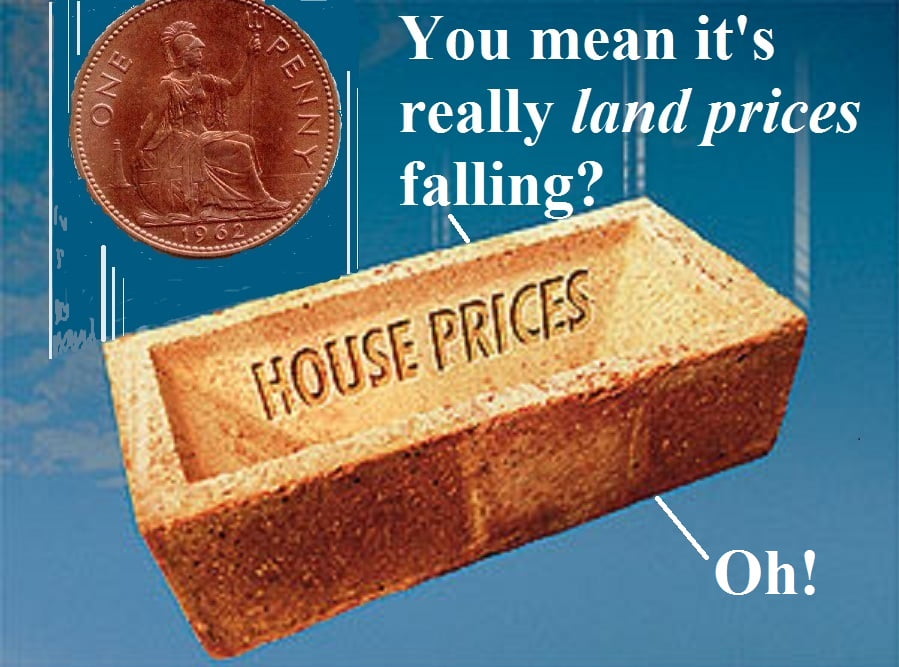
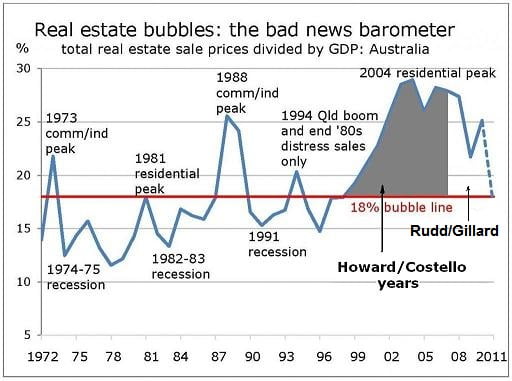
Those Australians continuing to buy residential property are either exceptionally wealthy–and don’t mind their purchase price looking very stupid shortly–or ignorant of Prosper Australia’s “Don’t Buy Now!” campaign:-

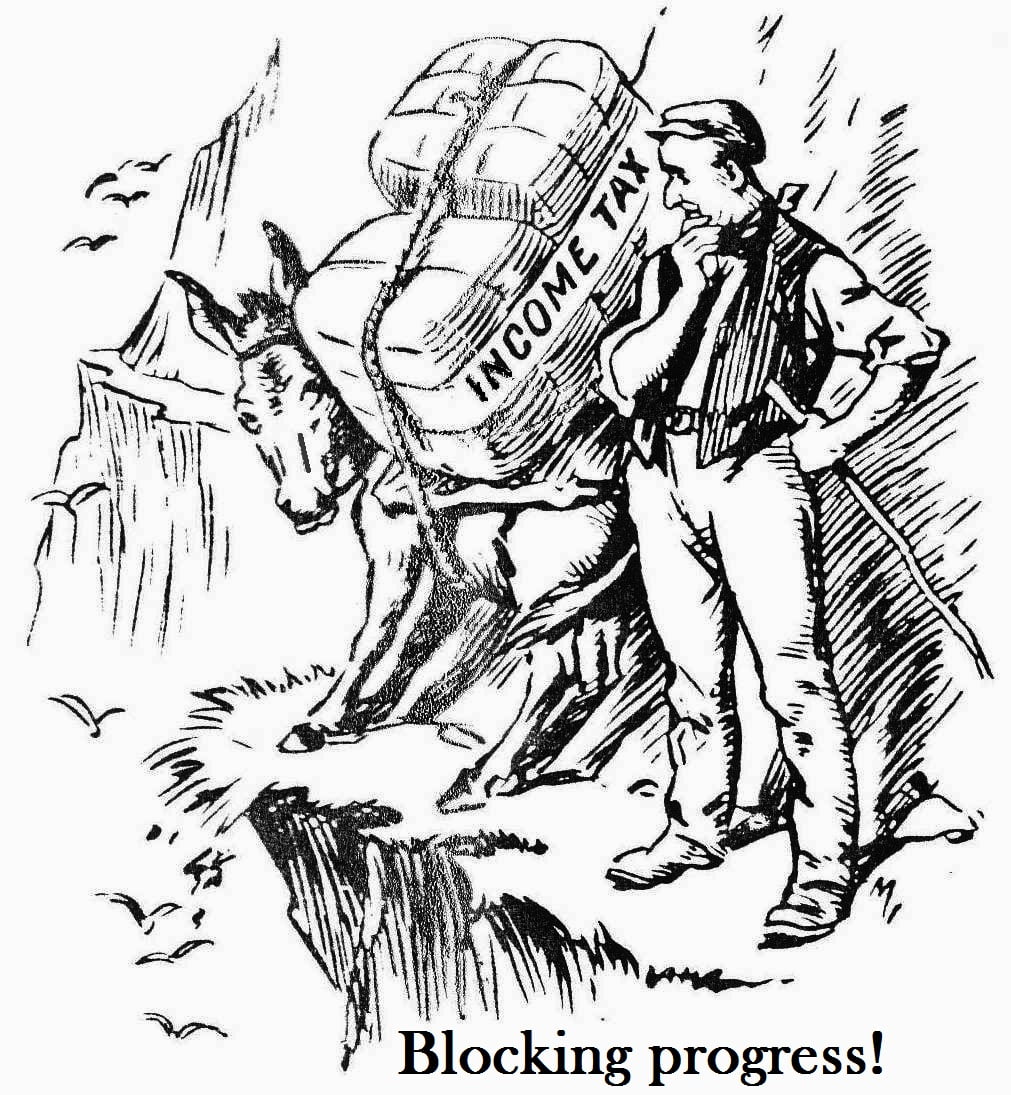
Around the world, elites continue to design revenue systems to suit their own selfish interests.
When after a period of time people are drawn to protest at increasing evidence of the social and economic damage caused by direct taxation, the 0.1% goes along with a switch to indirect taxes – and, some years after this has been put into practice, things of course need to go vice versa. Alternation between one failed revenue source to another. This alternation is promoted in the media as ‘tax reform’.
Their other constant over the last century has been to wind back taxes on real estate assiduously – particularly on land.
For more than 130 years, Georgists have demonstrated without much success that this is a travesty of ‘free enterprise’. It is not even a ‘capitalist’ system, but a system of plutocrats stealing the public’s rent.
Instead of liberty and free enterprise we exist under a system of rentierism.
Rentierism breaks into a recession with monotonous regularity, and a little less regularly into the devastation we are now witnessing when a gargantuan bubble in land prices bursts .
But our attention span is limited, so we believe each partial recovery is a real recovery. The rentiers take the opportunity to blame the preceding financial collapse on property-based taxation, which is therefore wound back further. Some of the non-rentier fraudsters who believed they could match the rentier class in accumulation of corrupt wealth are usually thrown into jail for their criminality. The rentier remains invisible throughout this process, and as time passes the land price bubbles grow progressively larger.
We don’t ‘get it’, you see? Whilst we ought to be abolishing all taxes on labour and capital, whether direct or indirect, and making everyone pay the full annual rent for exclusive possession of the lands over which they’ve been granted title, we’re constantly re-assured by their neo-classical high priests that all’s OK, a new economic day has dawned. [They’re still not openly reporting this one as a depression yet – because we’ve got to mask the fatal flaw with CONfidence. “We’ll wait until all the ‘technical definitions’ of economic depression have been satisfied.”]
And so we resort to financial stupidity instead of introducing a revenue regime that, not fining labour and capital, will free humanity.
Rentierism still rules – and won’t go down without the odd fight in the High Court.

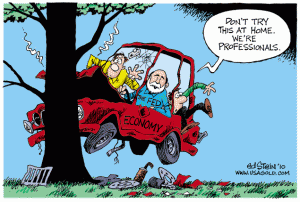
 We had a feeling Australian real estate spruikers were lying to us about a grave undersupply of housing, just as Southern Californian realtors did in an effort to explain nosebleed high prices before their bubble burst. But now we have the evidence.
Granting such licence to the real estate industry is no joke. The manner in which its boffins are permitted to lie to us has devastating social and economic consequences.
It’s got to change.
Until spruikers are read the Riot Act, Australia’s real estate valuers should ensure they keep arms length from them.

REAL ESTATE STATISTICS
The Lands Titles Office of South Australia is the nation’s most timely in the production of real estate sales data.
The release today of South Australia’s June sales total, 4510 sales aggregating a consideration of $1,495,172,843 (for all residential, commercial, industrial and rural sales), brings the financial year to a close.
The number and value of sales are the highest for the year, but June is not uncommonly South Australia’s greatest sales month.
| 2012 | ||
| Month | No. | Value |
| July | 3267 | $1,100,444,283 |
| Aug | 3395 | $1,125,757,597 |
| Sept | 3738 | $1,163,015,773 |
| Oct | 3212 | $993,334,293 |
| Nov | 3147 | $1,039,766,644 |
| Dec | 3655 | $1,273,103,908 |
| Jan | 3153 | $1,059,264,428 |
| Feb | 3132 | $988,340,919 |
| Mar | 3657 | $1,250,436,853 |
| Apr | 3246 | $1,098,745,548 |
| May | 3597 | $1,151,606,949 |
| June | 4510 | $1,495,172,843 |
| Total | 41709 | $13,738,990,038 |
| Mean | sale | $329,401 |
The following graph tracks the dollar value of South Australia’s real estate sales over the period of the bubble from 1999.
Following an attempted recovery in 2010, the last two years seem to confirm the end of the state’s property bubble.
South Australians should see a return to the long term trend over the next few years and much more affordable accommodation for home seekers. This is most heartening.


I often see articles sympathetic to the banks, claiming they’re hard done by, and most certainly not responsible for the global financial collapse.
Holding the banks to be the epitome of financial rectitude, and apparently not responsible for their own risk management, they lump the blame onto miscreant borrowers.
When some clown called Irvine Renter recently said Robert Shiller has completely lost his mind in suggesting banks carry responsibility, I flew into a rant:
“I know who’s lost his mind – and it aint Robert Shiller. Banks who lend on bubble-inflated land prices have deep structural problems with their risk management procedures – problems bordering on fraud. Of course they should adjust their loan books back to the real market and renegotiate loans from there.
After hundreds of years, banks don’t know that real estate bubbles burst? C’mon! They want to tie mortgagors down to 30 year sky high mortgages – then expect to be bailed out when things go awry.
Guess where your true moral hazard lies, guys? It aint with Joe Sixpack.”
I expect those people who hold the FIRE sector (viz, finance, insurance and real estate) to be the paragons of morality–thereby helping to underpin the rationale behind obscene bank bailouts–will also find excuses for Barclays and other British banks for fiddling their LIBOR rates.
Their claim that criticising banks is “bank bashing” is every bit as hollow and meaningless as those who claim land taxes are “wealth taxes”. (What on earth does that mean anyhow?)
The sorry state into which the banking industry has descended won’t be reformed by bailing it out for its sins: it must be permitted to go to the wall and be replaced by private interests or governments unprepared to finance real estate bubbles.
As with calls for further financial regulation, the argument that we need to save such a fatally flawed financial system doesn’t hold water.
“The Bureau of Statistics says Tasmanian dwelling approvals in May fell by 12.1 per cent, in seasonally adjusted terms.”
“The Housing Industry Association’s Stuart Clues says there has been no good news for the industry for months.”
[Sigh!]